
CARE 6-12 Brings Environmental Research to Chicago Public Schools
Chicago Public Schools (CPS) science teachers recently received a rare opportunity to step into the role of environmental researchers thanks to an exciting new initiative: CARE 6–12. This unique professional learning experience, funded by an Innovation Grant from the Schreiber Venture Fund, was designed to deepen science education by connecting teachers directly with hands-on environmental research.
Building on the success of the NSF-funded undergraduate CARE (Community Air-Quality Research Experience) project, led by Dr. Ping Jing, professor of environmental science at Loyola University Chicago, CARE 6–12 brought a fresh focus on middle and high school educators. The project provided eight CPS teachers from grades 6–12 with an immersive experience in air-quality science that will ultimately enrich the learning experience of hundreds of students across the city.
Designed through a partnership between LUC’s School of Environmental Sustainability (SES) and Center for Science and Math Education (CSME), CARE 6–12 was structured as a multi-phase program that began in the spring with regular cohort meetings. These gatherings provided participating teachers with a strong foundation in the science and significance of air quality: a pressing issue in many urban environments, including Chicago. Teachers were introduced to air-quality monitoring tools and trained to use portable air sensors to gather data from their own communities.
Part of what made CARE 6–12 especially unique was the involvement of LUC undergraduate students, who had the opportunity to share and develop their own expertise while supporting educators. While the professional learning sessions were designed and facilitated by CSME and SES, four undergraduate students with backgrounds in environmental science and data science played an active role in the program.
These undergraduate students assisted CPS teachers in formulating research questions, collecting and analyzing environmental data, and communicating results. Their participation not only strengthened the support network for teachers but also modeled collaborative, interdisciplinary research in action, showing how science education can bridge classroom learning and community-based inquiry.
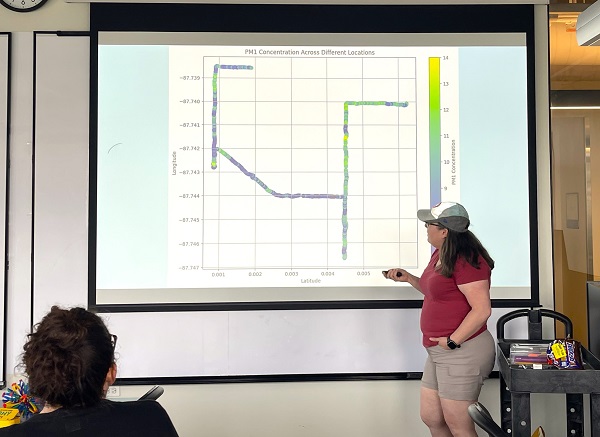
The highlight of the CARE 6–12 program occurred during the summer institute, an intensive four-day session where educators came together to analyze the air-quality data they collected. During this collaborative time, teachers sharpened their data literacy skills, interpreted environmental trends, and developed meaningful conclusions. They also began the process of translating their findings into student-facing projects—hands-on, inquiry-driven lessons that will allow CPS students to engage in real scientific research in the classroom.
This process ensured that the impact of CARE 6–12 will reach far beyond the participating teachers. It empowers students to investigate environmental issues in their own neighborhoods and equips them with tools to think critically about science, data, and community health.
Programs like CARE 6–12 highlight the power of partnerships between higher education institutions and K–12 schools. By investing in teacher development, the program supports long-term improvements in science education and cultivates a new generation of students who are scientifically literate and environmentally aware.
With the backing of the Schreiber Venture Fund and the expertise of CSME and SES, CARE 6–12 is a shining example of how innovative thinking can reshape science education and make real-world research accessible to teachers and students alike.
For more information about the CARE 6-12 initiative or to learn how to support similar projects, email csme@luc.edu.
Chicago Public Schools (CPS) science teachers recently received a rare opportunity to step into the role of environmental researchers thanks to an exciting new initiative: CARE 6–12. This unique professional learning experience, funded by an Innovation Grant from the Schreiber Venture Fund, was designed to deepen science education by connecting teachers directly with hands-on environmental research.
Building on the success of the NSF-funded undergraduate CARE (Community Air-Quality Research Experience) project, led by Dr. Ping Jing, professor of environmental science at Loyola University Chicago, CARE 6–12 brought a fresh focus on middle and high school educators. The project provided eight CPS teachers from grades 6–12 with an immersive experience in air-quality science that will ultimately enrich the learning experience of hundreds of students across the city.
Designed through a partnership between LUC’s School of Environmental Sustainability (SES) and Center for Science and Math Education (CSME), CARE 6–12 was structured as a multi-phase program that began in the spring with regular cohort meetings. These gatherings provided participating teachers with a strong foundation in the science and significance of air quality: a pressing issue in many urban environments, including Chicago. Teachers were introduced to air-quality monitoring tools and trained to use portable air sensors to gather data from their own communities.
Part of what made CARE 6–12 especially unique was the involvement of LUC undergraduate students, who had the opportunity to share and develop their own expertise while supporting educators. While the professional learning sessions were designed and facilitated by CSME and SES, four undergraduate students with backgrounds in environmental science and data science played an active role in the program.
These undergraduate students assisted CPS teachers in formulating research questions, collecting and analyzing environmental data, and communicating results. Their participation not only strengthened the support network for teachers but also modeled collaborative, interdisciplinary research in action, showing how science education can bridge classroom learning and community-based inquiry.
The highlight of the CARE 6–12 program occurred during the summer institute, an intensive four-day session where educators came together to analyze the air-quality data they collected. During this collaborative time, teachers sharpened their data literacy skills, interpreted environmental trends, and developed meaningful conclusions. They also began the process of translating their findings into student-facing projects—hands-on, inquiry-driven lessons that will allow CPS students to engage in real scientific research in the classroom.
This process ensured that the impact of CARE 6–12 will reach far beyond the participating teachers. It empowers students to investigate environmental issues in their own neighborhoods and equips them with tools to think critically about science, data, and community health.
Programs like CARE 6–12 highlight the power of partnerships between higher education institutions and K–12 schools. By investing in teacher development, the program supports long-term improvements in science education and cultivates a new generation of students who are scientifically literate and environmentally aware.
With the backing of the Schreiber Venture Fund and the expertise of CSME and SES, CARE 6–12 is a shining example of how innovative thinking can reshape science education and make real-world research accessible to teachers and students alike.
For more information about the CARE 6-12 initiative or to learn how to support similar projects, email csme@luc.edu.